How to Scrape Qunar (去哪儿) Hotel Reviews (2026 Guide)
Qunar (去哪儿) is the price-led China-market brand in the Trip.com Group, and it runs one of the largest Chinese-language hotel review systems anywhere - busy properties carry thousands of reviews. Almost none of it is covered by Trip.com or Ctrip scrapers, and there is no public API. This guide covers what you can extract, why building your own scraper stalls, and the fastest way to get clean, structured Qunar review data.
Why scrape Qunar reviews?
- Reputation monitoring - track your hotel's Qunar rating, recommend rate and fresh reviews over time.
- Competitor benchmarking - compare ratings, sub-scores and sentiment across rival hotels.
- Domestic-China intelligence - Qunar's audience is mainland travelers, the corpus Western OTAs miss.
- AI & RAG - build a Chinese review dataset for sentiment models and travel assistants.
What data can you get?
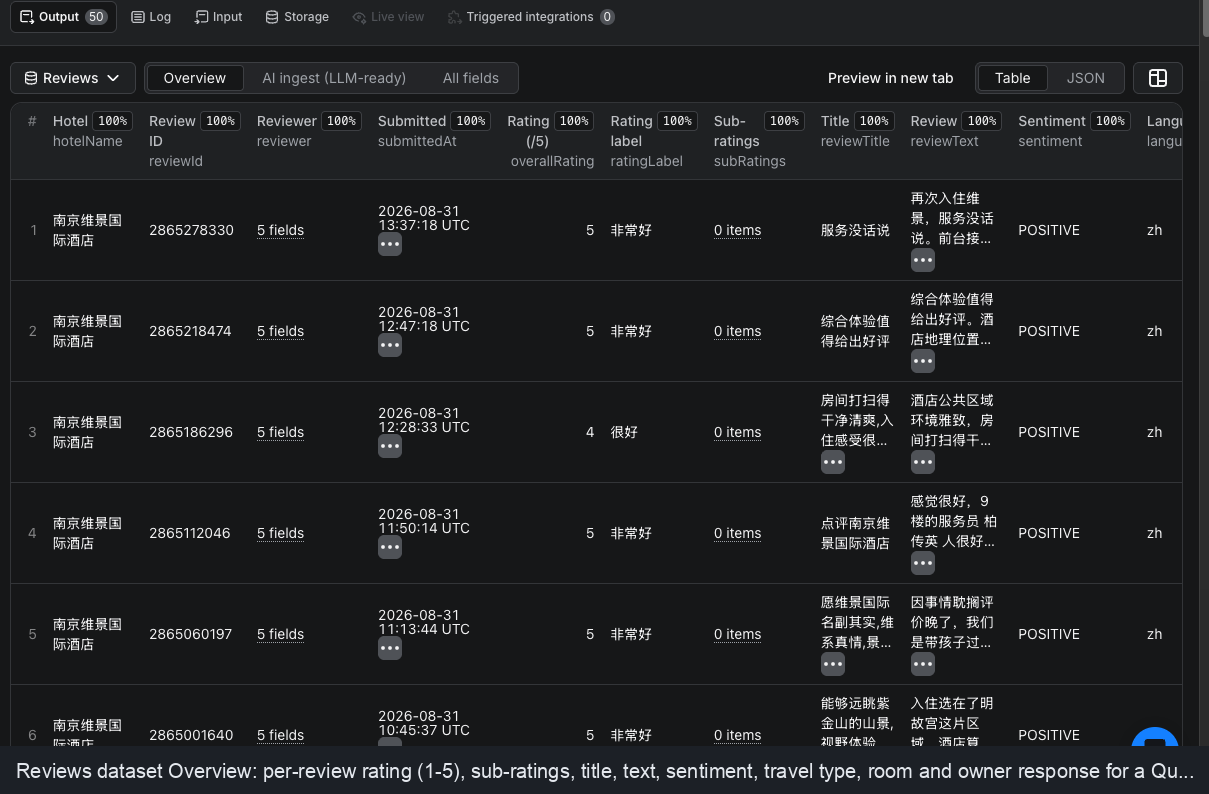
Per review: a 1-5 rating and rating label, per-review sub-ratings (service, location, facilities, cleanliness), the review title and body, a POSITIVE / NEGATIVE / NEUTRAL sentiment, travel type, room name, photos, the hotel's owner response, the reviewer profile, and an LLM-ready markdownContent block. Every row is tagged with its origin (reviewSource) so you always know whether a review was written natively on Qunar or aggregated from Ctrip. A paired Hotels dataset gives one summary row per hotel: overall score, recommend rate and sub-scores.
Why building your own breaks
The reviews you see on a Qunar hotel page load separately after the page renders, so a simple HTML parser misses them. On top of that the reviews are Chinese-language only, and Qunar mixes reviews written natively on Qunar with reviews it aggregates from Ctrip, undifferentiated. Rolling your own means handling that loading flow, paging through results, and tagging each row's origin yourself - and keeping it all working as the site changes layouts and pagination.
The fast way: the FactDen Qunar Hotel Reviews Scraper
The Qunar Hotel Reviews Scraper on Apify does it in one run. You can:
- Paste hotel URLs - like
https://hotel.qunar.com/cn/nanjing/dt-17/orhttps://hotel.qunar.com/cn/shanghai_city/dt-297/, up to 100 hotels per run. - Or use composite IDs - in
{city}_{id}form, e.g.nanjing_17orshanghai_city_297. - Sync incrementally - set a
fromDatecutoff; reviews are read newest-first, so it stops at the boundary instead of scanning the whole history. - Export to JSON, CSV, Excel, or pull from the API on a schedule.
No login, no API key. Rating filtering is done downstream - every row carries overallRating and sentiment. Field docs and code snippets are in the GitHub repo.
What does it cost?
$4 per 1,000 reviews, dropping toward $3 per 1,000 at volume, plus a small per-run start fee, pay-per-result. New Apify accounts get free platform credit to try it end to end before any real spend.
Frequently asked questions
- Does Qunar have a reviews API?
- No public one. The reviews load separately, not in the page HTML. This scraper is the structured alternative - JSON or CSV, no login.
- Is Qunar the same as Ctrip or Trip.com?
- Qunar (去哪儿) is a separate brand in the same Trip.com Group - the domestic-China, price-led site. It shows native Qunar reviews plus Ctrip-aggregated ones; the scraper returns both, tagged by origin.
- Are the reviews translated?
- No. Qunar serves Chinese-language reviews with no machine translation; the scraper returns the original text as shown.
Try the Qunar Hotel Reviews Scraper →
Related guides: How to scrape Trip.com & Ctrip reviews → · How to scrape Fliggy reviews →